
You found some small, dark specks near a window frame or along a baseboard. Now you are wondering whether these droppings tell you about a carpenter ant problem, a termite problem, or nothing to worry about at all.
The answer matters a lot because these two pests cause very different types of damage and require very different responses.
Here is how to tell carpenter ant droppings and termite droppings apart, what each one means for your home, and when to call for professional intervention.
What Do Carpenter Ant Droppings Look Like?
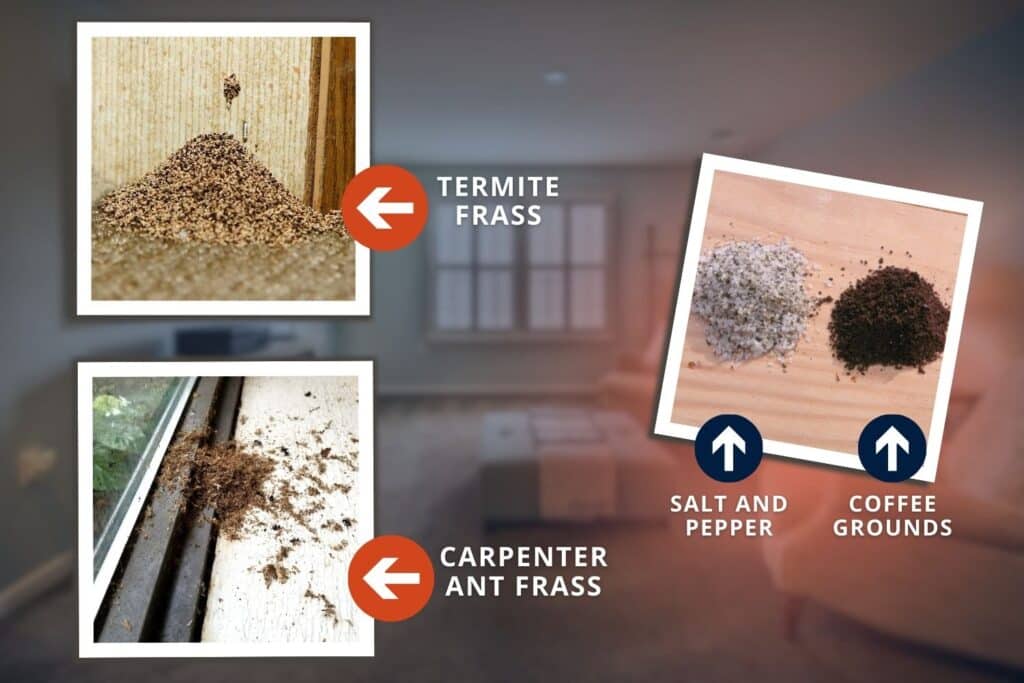
Carpenter ant droppings are not actually waste in the traditional sense. What you are seeing is called frass, and it is a mix of chewed wood shavings, debris, dead ant body parts, and other material that carpenter ants push out of their nests as they excavate.
The ant frass tends to look coarse and fibrous, almost like small wood shavings or pencil shavings mixed together. It is usually light tan or grayish in color and has a rougher, more irregular texture.
You will often find it in small piles below entry points or along baseboards, window sills, or door frames.
What to look for:
- Coarse, fibrous texture with jagged edges
- Light tan, gray, or wood-colored appearance
- Mixed with insect parts, soil, or debris
- Found near wood surfaces, often below small exit holes
If you sweep it up and it comes back within a few days, that is a strong sign of an active infestation. Carpenter ants do not eat wood the way termites do. They excavate it to build smooth-walled galleries for nesting, and they keep pushing frass out as the colony grows.
What Do Termite Droppings Look Like?
Termite droppings, called frass as well, but in a very different form, come specifically from drywood termites.
Drywood termites are common in Texas, and unlike subterranean termites, they do not use their waste to build mud tubes. Instead, they push it out of small kick-out holes in the wood they are infesting.
Termite frass is much more uniform and distinctive than carpenter ant frass. The pellets are tiny, hard, and oval-shaped with six concave sides.
They are often described as looking like coffee grounds, coarse sand, or tiny seeds. Color can range from light beige to dark brown, depending on the type of wood the termites are feeding on.
What to look for:
- Tiny, uniform oval pellets with ridged sides
- Resembles fine sand, coffee grounds, or poppy seeds
- Color varies from cream to dark brown
- Found in small, neat piles near kick-out holes in wood
The piles tend to look almost too tidy. That is because termites are actively pushing waste out through a small opening. If you find a neat little mound of uniform pellets with no visible source, that is a significant red flag.
Carpenter Ant Droppings vs Termite Droppings at a Glance
| Dropping Trait | Carpenter Ant Frass | Termite Droppings |
| Texture | Coarse, fibrous, irregular | Fine, uniform, pellet-shaped |
| Color | Tan, gray, mixed tones | Cream to dark brown |
| Shape | Jagged, mixed debris | Tiny ovals with ridged sides |
| Looks like | Wood shavings and debris | Sand, coffee grounds, tiny seeds |
| Contains | Wood bits, insect parts | Compacted fecal pellets only |
| Found near | Exit holes in wood, baseboards | Small kick-out holes in wood |
Where Are You Likely to Find Each One?
Location matters as much as appearance when you are trying to figure out what you are dealing with.
Carpenter ant frass tends to show up near moisture-damaged wood. Carpenter ants are drawn to soft, wet, or rotting wood because it is easier to excavate.
In Texas homes, that often means around window frames, door frames, crawlspaces, rooflines, and areas with prior water damage or leaks. If you have had any kind of moisture issue in your home, check those areas first.
Termite droppings from drywood termites are more commonly found near wood trim, furniture, door frames, hardwood floors, and structural framing. The kick-out holes are small and easy to miss, but the pellet piles below them are usually what homeowners notice first.
In The Woodlands, Conroe, and Spring areas, drywood termite pressure is real year-round thanks to the warm, humid climate.
Subterranean termites, which are actually the most destructive and most common termite species in Texas, do not leave visible frass in the same way. Instead, they leave mud tubes along foundations, piers, and wall surfaces.
If you are finding mud tubes rather than frass pellets, that points to subterranean termites, which require a different treatment approach entirely.
Other Signs of Carpenter Ants vs Termites
Droppings alone do not always tell the full story. Here are other signs to watch for alongside what you have found.
Signs of carpenter ants:
- Rustling or crunching sounds inside walls, especially at night
- Large, black or red-black ants (usually 0.5 to 1 inch) inside the home
- Small, round exit holes in wood surfaces
- Smooth, clean-walled galleries if wood is opened up
- Swarmers in spring are typically larger than termite swarmers
Signs of termites:
- Mud tubes on foundation walls, piers, or crawlspace framing
- Hollow-sounding wood when tapped
- Paint that bubbles or peels without a moisture source
- Tight-fitting doors or windows that suddenly stick
- Swarmers in spring with equal-length wings and straight antennae
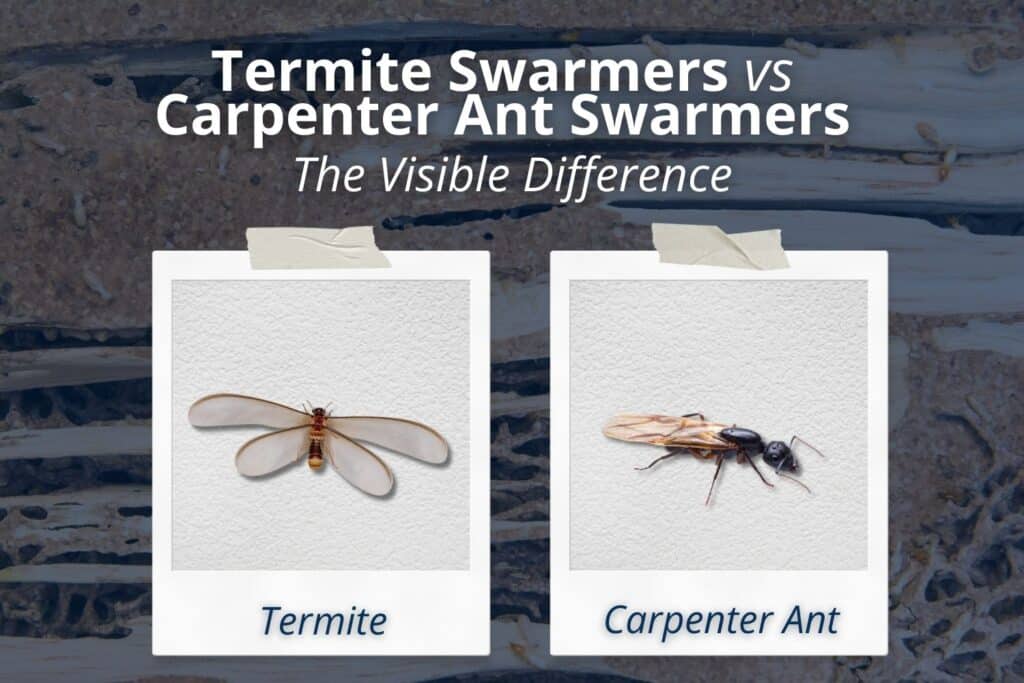
One of the most common points of confusion is termite swarmers vs ant swarmers. Both show up in spring, and both can end up inside your home.
Termite swarmers have straight, beaded antennae, a thick waist, and wings of equal length.
Carpenter ant swarmers have bent antennae, a narrow waist, and front wings that are noticeably longer than the back wings.
Does Finding Droppings Mean You Have Structural Damage?
Not necessarily, but it does mean the problem needs attention right away. Neither carpenter ants nor termites do their worst damage overnight.
The real issue is that by the time droppings are visible, the colony is usually well-established and has been active for a while.
Carpenter ants do not eat wood for nutrition, but their galleries weaken structural members over time, especially in areas already compromised by moisture.
A large or long-established carpenter ant colony can do serious damage to framing, sills, and joists.
Termites are capable of causing significant structural damage before most homeowners ever notice a single sign.
Drywood termites work slowly compared to subterranean termites, but a mature colony left unchecked can hollow out structural wood from the inside. Subterranean termites are faster and more aggressive, and their damage is often extensive by the time it is discovered.
The bottom line: if you are finding droppings of either type, the right move is a professional termite inspection, not a wait-and-see approach.
Other Pest Questions Texas Homeowners Ask
What is the difference between drywood and subterranean termites?
Drywood termites live inside the wood they infest and leave visible frass pellets. Subterranean termites live underground and travel to food sources through mud tubes. Subterranean termites are more common and more destructive in Texas, but both species are present in the Houston-area region.
What does a termite inspection involve?
A professional termite inspection covers all accessible areas of the structure, including the foundation, crawlspace, framing, and exterior wood. The inspector looks for live activity, damage, mud tubes, frass, and swarmers. In Texas, where termite pressure is high year-round, an annual inspection is a smart investment.
How do you prevent termites in Texas?
Prevention includes reducing wood-to-soil contact around your foundation, fixing moisture issues promptly, keeping firewood stored away from the home, and scheduling regular termite inspections.
A termite prevention plan with a licensed pest control company is the most reliable long-term defense for homes in The Woodlands, Conroe, and Spring areas.
When to Call a Professional
If you found droppings and are not sure what you are dealing with, do not wait. Both carpenter ants and termites get harder to treat the longer they go unaddressed. Here is what Grand Slam Pest Control can help with:
- Termite Inspection: Know exactly what you are dealing with before any damage gets worse
- Termite Control: Targeted treatment to eliminate an active infestation
- Termite Prevention: Ongoing protection so termites never get a foothold in the first place
- Fire Ant Control: Whole-yard treatment for one of Texas’s most aggressive pests
- Mosquito Control: Fogging and misting systems to take back your yard
- Rodent Control: Fast, effective service if you are also seeing signs of rodent activity
- General Residential Pest Control: Quarterly maintenance plans that keep your home protected year-round
Grand Slam serves homeowners across The Woodlands, Conroe, Spring, and surrounding areas. If something looks off in or around your home, we will tell you exactly what it is and what it takes to fix it.
Conclusion
Finding droppings is your home’s way of telling you something is wrong. Whether it turns out to be carpenter ants or termites, the earlier you act, the better your outcome. These are not pests that resolve on their own, and in Texas, where the climate keeps insects active for most of the year, waiting only gives a colony more time to grow.
When in doubt, get a professional set of eyes on it. A quick inspection is a lot less stressful than discovering structural damage down the road.