If you spot something black and yellow buzzing near your eaves or your kids’ play area, the species matters more than you might think. Hornets and yellow jackets look similar, but they nest in different places, behave differently, and require different removal approaches.
At Grand Slam Pest Control, we treat both residential and commercial properties in The Woodlands, Spring, and Conroe. This guide covers everything you need to know to tell them apart before you get too close.

How to Tell a Hornet from a Yellow Jacket at a Glance
The fastest way to separate a hornet from a yellow jacket is by size, color, and where the nest sits.
Size and Color
| Feature | Yellow Jacket | Bald-Faced Hornet |
| Length | About 1/2 inch | About 3/4 inch |
| Color | Bright yellow and black banding | Black body, white face markings |
| Body shape | Compact, sleek, narrow waist | Thicker, fuller-bodied |
| Hairiness | Hairless and shiny | Hairless and shiny |
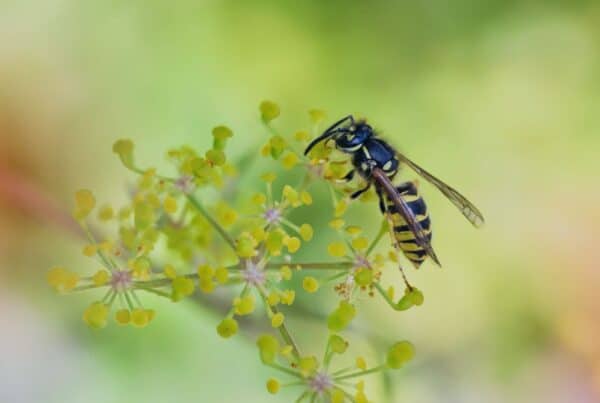
Yellow jackets have bright lemon-yellow and black stripes, with anchor-shaped black marks near the head. The bald-faced hornet is the species most homeowners in the Houston area run into. It has no yellow at all: it is black with white or ivory markings on its face, upper thorax, and the tip of its abdomen.
The European hornet is a true hornet and is less common in Texas. It is larger still, roughly 1 inch long, with brown and yellow coloring rather than the stark black-and-white of the bald-faced variety.
Nest Location and Shape
Nest location is the clearest real-world clue. If you see insect traffic going in and out of a hole in the ground near a shrub or fence post, that is almost always a yellow jacket. If you see a large, gray, football-shaped paper structure hanging from a branch or eave, that is a bald-faced hornet nest.
| Nest trait | Yellow Jacket | Bald-Faced Hornet |
| Location | Underground, wall voids | Aerial, trees, eaves, shrubs |
| Shape | Hidden, no visible exterior | Enclosed, football or basketball-shaped |
| Material | Paper pulp, interior only | Paper pulp, fully enclosed |
| Colony size at peak | Up to 15,000 workers | Several hundred workers |
Yellow jackets often move into abandoned rodent burrows, with entrances about 1 to 2 inches wide. Their nests grow inside walls, under landscaping, or along foundations.
They are almost impossible to spot until the colony is large. Hornet nests hang in the open and are visible early in the season, which actually gives homeowners a chance to address them before colonies reach full size in August.
According to the University of Florida IFAS Extension, the bald-faced hornet is technically a yellow jacket by classification, not a true hornet, but it nests above ground and matches what most people mean when they say “hornet” in our region.
Yellow Jacket Behavior: Why They Sting More Often
Yellow jackets are behind most stinging incidents in the Houston area. They are fast, defensive, and willing to chase a perceived threat well beyond the nest.
A few things make them particularly dangerous here:
- Ground nests near foot traffic. Eastern yellow jackets often build in soft soil under mulch beds, slopes, and lawn areas. A single mower pass or a child running through the yard can disturb a colony of thousands.
- Late-summer aggression. August is peak season. Colonies reach their largest size, and the workers switch from hunting protein to scavenging sugar, which is why yellow jackets swarm outdoor meals and open drink cans.
- Alarm pheromones. When a yellow jacket is crushed or the nest is disturbed, it releases a chemical that tells other workers to attack. Dozens can emerge within seconds.
- Sting repeatedly. Unlike honeybees, yellow jackets do not lose their stinger. One insect can sting multiple times.
Yellow jackets also nest inside wall voids and soffits when they cannot find ground space. If you hear buzzing from inside a wall during summer, yellow jackets are a common culprit.
Learn more about the stinging insects covered in our residential pest control plans.
Hornet Behavior: Territorial but Predictable
Bald-faced hornets are aggressive near their nest but more predictable than yellow jackets in open spaces. They do not scavenge at outdoor meals, so you are less likely to encounter one at your picnic table.
The key risk with hornets is proximity to the nest. A bald-faced hornet colony defends a wide perimeter, and any vibration or fast movement near the nest can trigger a response. By August, a mature nest holds several hundred workers and can grow to the size of a basketball.
What to watch for on your property:
- A gray, papery, enclosed globe hanging from a tree branch, eave, deck, or outdoor structure
- Heavy flight activity around a single point, 3 feet or more off the ground
- Black-and-white insects that are noticeably larger than the yellow-and-black wasps you normally see
Do not try to knock down a hornet nest with a stick or spray it from a can. The nest can house hundreds of workers, and disturbing it at close range puts you at serious risk of a mass attack.
Which Species Live in The Woodlands and the Houston Area?
Texas is home to several stinging insects, and the species matter for treatment. The ones Grand Slam handles most often in The Woodlands, Spring, and Conroe include:
- Southern yellow jacket (Vespula squamosa): The most common and aggressive yellow jacket in Houston. Nests underground, can build colonies that expand for years. Common in yards and near foundations.
- Eastern yellow jacket (Vespula maculifrons): Also ground-nesting. Often found in landscaping and lawn areas.
- Bald-faced hornet (Dolichovespula maculata): Builds aerial paper nests. Common in trees and on structures. Most active summer through early fall.
- Paper wasp: Less aggressive than yellow jackets, builds small open-comb nests under eaves and porch ceilings. Often confused with yellow jackets, but are distinct by their dangling legs in flight.
The bald-faced hornet actually thrives in the southeastern United States, which means homeowners in the Houston metro need to take nest sightings seriously year-round.
Our general pest control service covers stinging insects within 10 feet of the home and up to 20 feet off the ground.

Related Questions to Explore
Are yellow jackets more aggressive than hornets?
Yes. Yellow jackets are generally more aggressive than bald-faced hornets when it comes to everyday encounters. Yellow jackets scavenge for food and actively patrol their territory, making accidental contact more common. Hornets are territorial near their nest but tend to avoid open areas away from it. Both can sting multiple times, and both become more defensive as colonies grow larger in late summer.
What does a yellow jacket nest look like vs. a hornet nest?
A yellow jacket nest is usually hidden. The entrance is a small hole in the ground, roughly 1 to 2 inches wide, with constant worker traffic. The nest itself is underground or inside a wall void and looks like layered paper combs with no visible exterior. A hornet nest is fully enclosed and hangs in the open. It has a smooth, gray-brown papery surface and a small entrance hole near the bottom. Hornet nests are much easier to spot early in the season.
Can yellow jackets sting multiple times?
Yes. Yellow jackets do not lose their stinger the way a honeybee does, so a single yellow jacket can sting multiple times. When a nest is disturbed, they also release alarm pheromones that call in other workers fast. This is why a mower passing over a ground nest can result in dozens of stings in seconds.
What attracts yellow jackets to my yard?
Yellow jackets are drawn to protein and sugar. In early summer, they hunt insects to feed their larvae. By late summer, they shift to sweet foods, which is why they hover over outdoor meals, open drink cans, and ripe or fallen fruit. Poorly sealed trash cans, pet food left outside, and standing water can all increase activity. Reducing these attractants is one of the simplest ways to keep yellow jackets away from your outdoor spaces.
Is a bald-faced hornet actually a hornet?
Not technically. The bald-faced hornet belongs to the genus Dolichovespula, which makes it a yellow jacket by classification, not a true hornet in the Vespa genus. But it shares most behavioral traits with hornets: it builds an enclosed aerial nest, defends it aggressively, and is larger than the yellow jackets most people see at their cookouts. For removal purposes, treat it like a hornet.
When to Call a Professional
You should not attempt to remove a yellow jacket or hornet nest on your own in most situations. Here is when to call:
- You found a ground nest near foot traffic (walkways, lawn areas, play equipment, near AC units). These colonies can hold thousands of workers and react fast to vibration.
- The nest is inside a wall or soffit. Plugging the entrance hole forces workers to find another exit, often into your living space. Proper treatment requires getting the product inside the void.
- The aerial nest is larger than a tennis ball. By the time a hornet nest reaches this size, removal without protective gear and professional-grade product is dangerous.
- Anyone in the home has a known sting allergy. A single encounter with a disturbed colony can become a medical emergency fast.
- It is August or later. Late-season colonies are at peak population and peak aggression. This is the worst time to attempt DIY removal.
Grand Slam Pest Control’s residential plans cover hornets, wasps, and yellow jackets within 10 feet of your home and up to 20 feet off the ground. If you have a stinging insect problem in The Woodlands, Spring, or Conroe, we come back at no cost between quarterly treatments if the problem returns.
Contact us at grandslampest.com or call 832-299-4991 to get a free quote.
Conclusion
Hornets and yellow jackets are not the same pest, and treating them the same way can make a bad situation worse.
Key takeaways:
- Yellow jackets are smaller, brighter yellow, and nest underground or in wall voids. They are the most aggressive stinging insect in the Houston area.
- Bald-faced hornets are larger, black and white, and build visible aerial nests. Territorial near the nest, but less likely to bother you at the grill.
- August is the most dangerous month for both. Colonies are at full size, food is scarce, and aggression is at its peak.
If you have spotted a nest or are seeing unusual stinging insect activity on your property, reach out to Grand Slam Pest Control. Our residential pest control plans include stinging insect coverage, and we serve The Woodlands, Spring, and Conroe with a satisfaction guarantee.