This guide explains how to identify rat poop vs mouse poop, what each one says about the infestation, and This guide explains how to identify rat poop vs mouse poop, what each one tells you about the infestation, and when it’s time to call a professional.
Rat poop is roughly the size of an olive pit. Mouse poop is closer to a grain of rice. That size difference is the fastest way to tell which rodent is in your home, and it matters because rats and mice need different treatment plans. Grand Slam Pest Control sees both throughout the Spring, Conroe, and Woodlands area, and droppings are usually the first clue homeowners find.
Below, we break down what mouse and rat droppings look like, what fresh versus old droppings tell you, the health risks tied to both, and how to clean them up safely.
Rat Poop vs Mouse Poop at a Glance
The quickest way to identify rodent droppings is to compare size, shape, and location.
| Feature | Mouse Droppings | Rat Droppings |
|---|---|---|
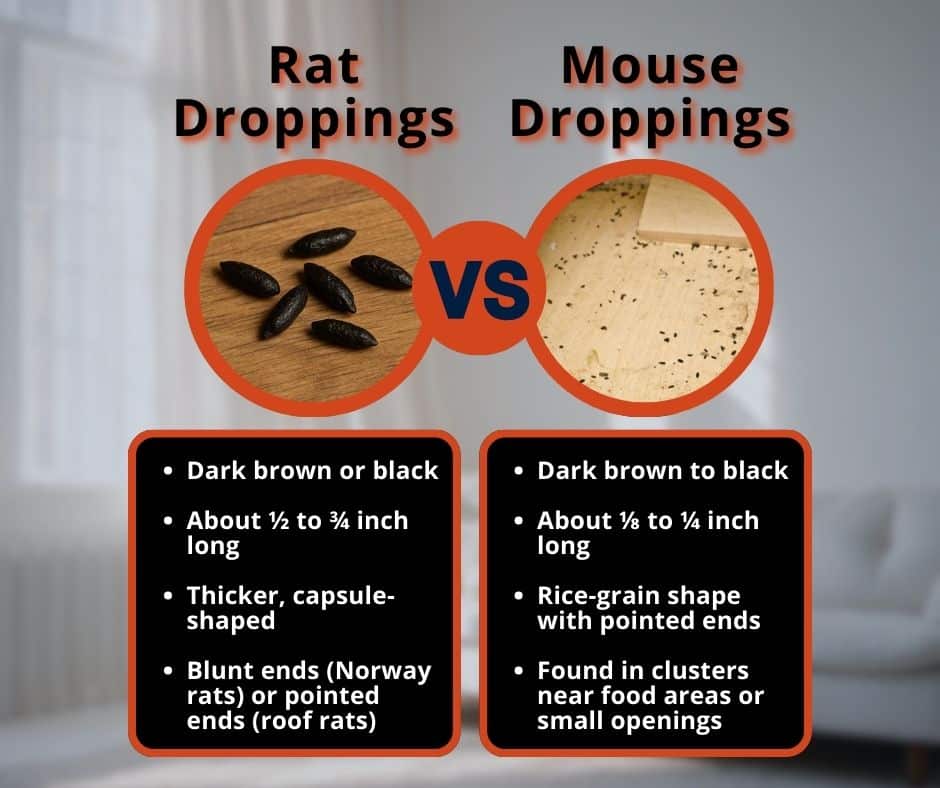
| Size | 1/8 to 1/4 inch | 1/2 to 3/4 inch |
| Shape | Rice-like, pointed on both ends | Capsule-shaped; blunt (Norway rats) or slightly pointed (roof rats) |
| Quantity | Many small pellets, often grouped | Fewer, larger pellets |
| Pattern | Scattered along travel paths | Clustered in repeat “latrine” spots |
| Common locations | Cabinets, pantry shelves, under sinks, closets | Attics, garages, behind appliances, along exterior walls |
| Rodent type | House mice | Norway rats or roof rats |
Mice tend to leave droppings anywhere they find food, since they eat small amounts often throughout the day. Rats are more cautious and usually stick to a handful of spots near their nest, so their droppings show up in tighter clusters.
Mild winters and high humidity around Spring, Conroe, and The Woodlands keep both species active nearly year-round instead of dying back in cold weather the way they might farther north.
Thick tree cover, AC line penetrations, and roofline gaps give rodents easy access to attics and crawlspaces, which is why droppings are often the first sign homeowners notice.

What Mouse Droppings Look Like
Mouse poop is small enough to miss at first glance, especially in dim cabinets or behind appliances.
Key features:
- About 1/8 to 1/4 inch long
- Rice-grain shape with pointed ends
- Dark brown to black when fresh, lighter brown as they age
- Often found in small clusters near food or nesting sites
Because mice revisit the same feeding spots several times a day, a pantry shelf or cabinet corner with more than a few pellets usually means an active mouse problem rather than a one-time visitor.
What Rat Droppings Look Like
Rat droppings are easier to spot, and their shape can even hint at which species you’re dealing with.
Key features:
- About 1/2 to 3/4 inch long
- Thick, capsule shape
- Blunt, rounded ends on Norway rats; slightly pointed ends on roof rats
- Dark brown to black when fresh, with a shine when very recent
Norway rats stay closer to the ground, so their droppings tend to turn up in crawlspaces, near foundations, and behind heavy appliances. Roof rats climb, so attics, roof lines, and upper wall voids are more common in Texas homes.
Fresh vs. Old Droppings: What They Tell You
Droppings change in appearance over time, and that change tells you whether rodents are still active.
Fresh droppings look shiny or slightly moist and may have a stronger odor. They point to rodents that are active nearby right now, often nesting or feeding within the past day or two.
Older droppings turn dry, dull, and gray, and they crumble easily when disturbed. Finding only old droppings can mean the rodents moved on, but a mix of fresh and old pellets in the same spot usually signals an infestation that has been building for a while.
Other Signs That Confirm Rats or Mice
Droppings are the clearest signal, but rodent behavior leaves other clues too.
Signs of mice:
- Small gnaw marks on food packaging
- Shredded paper, fabric, or insulation used as nesting material
- Scratching sounds low in walls or under cabinets
- Grease marks along baseboards where mice repeatedly brush past
Signs of rats:
- Chewed wiring, ductwork, or wood framing
- Larger gnaw marks and bigger entry holes
- Heavy movement or scratching in the attic at night
- Rat nests made from insulation, leaves, or shredded debris
Rats tend to stay away from unfamiliar objects for a few days, which is why fresh snap traps sometimes go untouched at first. Mice are bolder and usually approach new traps sooner.
How Species ID Changes the Treatment Plan
Getting the species right changes the treatment plan, not just the cleanup.
Mice reproduce quickly and spread horizontally through kitchens, closets, and interior walls. Removing them usually means sealing small gaps (mice fit through openings the size of a dime) and placing traps along the specific paths where droppings and grease marks show up.
Rats cause more structural damage since they chew wiring, ductwork, and framing, and they’re cautious around new objects, which makes standard snap traps less effective at first. Rat treatment typically involves a wider search for entry points and more attention to attic and exterior access.
A pest control technician who knows which species they’re dealing with can target the actual problem instead of guessing, which shortens how long the infestation lasts.
Health Risks Linked to Rodent Droppings
Both rat and mouse droppings can carry bacteria and viruses, though the specific risks differ slightly by species. Rats are more often linked to leptospirosis and rat-bite fever, while mice are the primary carrier in the U.S. for hantavirus pulmonary syndrome. According to the CDC, people are most often exposed when dried droppings, urine, or nesting material get stirred into the air and breathed in, not through direct contact alone.
That’s why sweeping or vacuuming dry droppings is one of the worst ways to clean them up. It’s also why the National Pest Management Association recommends a professional inspection any time droppings show up, since rodents get into an estimated 21 million U.S. homes each winter and often spread through several rooms before homeowners notice.
Diseases linked to rodent droppings include:
- Hantavirus pulmonary syndrome, spread mainly through airborne particles from dried droppings and urine
- Salmonellosis, from food or surfaces contaminated by droppings
- Leptospirosis, spread through contact with urine-contaminated water or soil
- Rat-bite fever, most often from a bite or scratch, but sometimes from contact with contaminated droppings
Children, pets, and anyone with respiratory conditions face a higher risk from airborne exposure, which is another reason to avoid dry-sweeping droppings even in a small, contained space.
How to Safely Clean Up Rodent Droppings
If you’ve confirmed a small, contained area of droppings, follow these steps:
- Ventilate first. Open windows and leave the room for 30 minutes before starting.
- Wear gloves and a mask. Rubber or latex gloves and an N95-style mask protect against airborne particles.
- Skip the vacuum and broom. Spray droppings with a disinfectant or a bleach solution (about 1 1/2 cups of bleach per gallon of water) and let it soak for 5 to 10 minutes before wiping up with a paper towel.
- Bag and seal the waste. Double-bag disposable materials before throwing them away.
- Disinfect the surface again once the droppings are removed, then wash gloves and any exposed clothing.
If you find a dead rodent along with the droppings, don’t handle it directly. Spray it with disinfectant first, then use gloves and a plastic bag to place it in a second sealed bag before disposal. Wash your hands thoroughly afterward, even if you wore gloves throughout.
For larger areas, attics, or anywhere you’re unsure how long the infestation has been active, a professional cleanup avoids the exposure risk entirely.
Related Questions to Explore
Can droppings tell me whether I’m dealing with rodents or another pest? Yes. Rodents leave firm, pellet-shaped droppings, while insects and other pests leave waste that looks noticeably different in shape and texture. If you’re not sure what you’re looking at, the pest library is a good place to compare.
Do rodents spread to other parts of the home once they get into the attic? Often, yes. Rats and mice travel through wall voids and gaps around ductwork, so activity that starts in one room can expand into garages, kitchens, or storage areas if entry points stay open.
Can rodent activity attract other pests? It can. Food debris and nesting material create conditions that draw in ants, roaches, and flies, so an increase in insect activity sometimes follows a rodent problem rather than showing up on its own.
How likely am I to get sick from rodent droppings? The risk is real but manageable with proper precautions. Fresh droppings in an enclosed space carry the highest risk, since airborne particles are the main way people are exposed, which is why cleanup method matters more than direct contact.
What’s the difference between Norway rat and roof rat droppings? Both are larger than mouse droppings, but Norway rat pellets have blunt, rounded ends, while roof rat pellets taper to a point. Norway rats also stay closer to the ground, while roof rats favor attics and rooflines.
When to Call a Professional
Contact a professional if you see droppings of any size, hear movement at night, or notice gnaw marks or insulation damage. Droppings only tell part of the story. Knowing how the rodents got in, and whether more are hiding elsewhere, takes an inspection.
A professional visit generally includes:
- Confirming whether droppings belong to rats or mice
- Checking attics, garages, and crawlspaces for activity
- Locating entry points around the roof, vents, and foundation
- Building a removal plan suited to the species involved
- Recommending exclusion work to keep rodents from returning
Grand Slam Pest Control specializes in tracing rodent pathways through attics and walls and sealing the openings that let them in, so current activity stops and new rodents can’t take its place.
Conclusion
Size is the fastest way to tell rat poop from mouse poop: rats leave larger, olive-pit-sized droppings, while mice leave smaller, rice-grain-sized ones. Freshness tells you how active the problem is, and location often points to which species you’re dealing with. Because droppings only show part of an infestation, a professional inspection is the surest way to confirm what’s in your home and stop it from spreading.
Get a quote from Grand Slam Pest Control for a full rodent inspection and a treatment plan built around what’s actually in your home.